
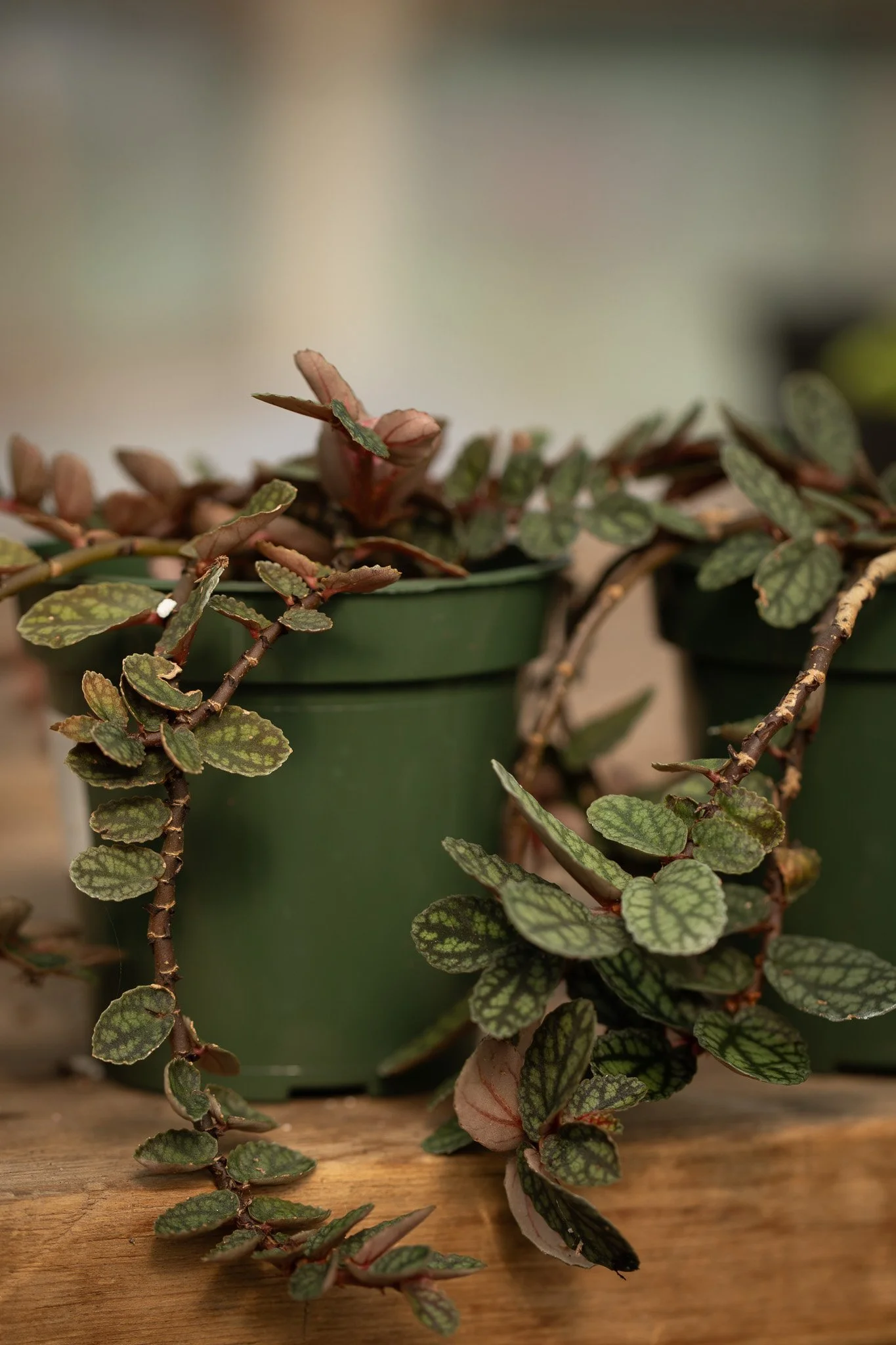
Procris repens - watermelon vine
If you’ve ever longingly noticed this plant over in the not for sale aisle, now is your chance to get one! We have a bunch potted up and ready for you. And my goodness, how cute are those little watermelon-looking leaves?
I also want to mention that this plant used to be called Pellonia repens, but was reclassified at some point. You will still see it both ways, so just know that it is, indeed, the same plant!
Light
Bright, indirect light. If it gets too much direct sun and the leaves will scorch.
Water
Keep soil consistently moist through the growing season; ease off a bit in fall and winter. Good drainage is non-negotiable — this one won't tolerate soggy feet.
Soil
A well draining potting soil is non-negotiable for this one — itwon't tolerate soggy feet!
Growth habit
This one doesn’t get very tall ( a couple of inches), but it does creep up to a foot or so, rooting at the nodes wherever a stem touches soil. It’s great for hanging baskets, terrariums, or as a groundcover under taller houseplants.
Pro Tip: Because it roots so readily at the nodes, this is an easy one to propagate — a trailing stem pinned down onto moist soil will root in a couple of weeks.
Pet Safety:
NC State Extension lists Procris repens as non-toxic to dogs, cats, and horses. This exact species doesn't have its own dedicated ASPCA entry, so, as always, exercise caution.
Get Nerdy with Cara: Here's a fun contradiction: Watermelon belongs to the Urticaceae family, which is the nettle family, the same one that gives us stinging nettle's infamous hollow, needle-like hairs that inject formic acid on contact. Procris repens skipped that memo entirely. It does not have any stinging hairs, just soft, patterned foliage. It's a good reminder that plant family tells you about evolutionary relationships, not a guaranteed shared trait.