
(or not, it’s complicated…)
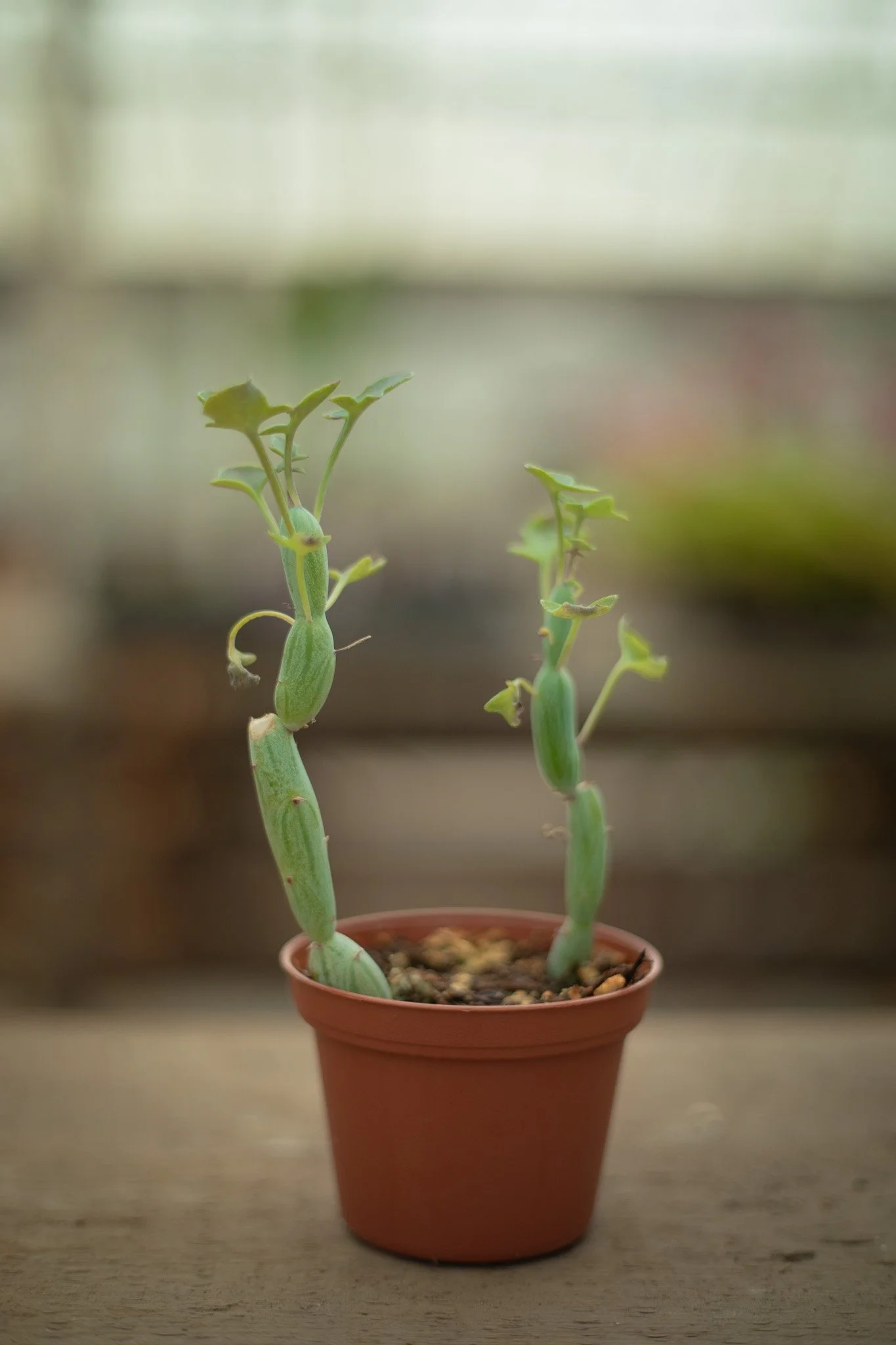
Senecio articulatus — or dancing tomato worms?
If you've ever wanted a houseplant that practically takes care of itself in summer, meet Senecio articulatus, the tomato worm plant (or sausage plant, candle plant, hot dog cactus…the list goes on). It spends the warm months quietly resting, then wakes back up just as the rest of the garden is winding down. Add in its sculptural, segmented stems, and you've got one of the coolest weirdos we have in the greenhouse.
Care:
Light
Bright light with some direct sun is ideal. Indoors, aim for at least 4–6 hours of good light daily.
Water
During its active season (roughly October through April), use the soak-and-dry method: water thoroughly, then let the soil dry out completely before watering again. In summer, when it's resting, back way off. Overwatering during dormancy is the most common way to lose this one.
Soil
Well-draining is non-negotiable. A quality cactus/succulent mix with extra perlite added works well. This plant does not want to sit in anything that holds moisture.
Pro-tip
In summer, the leaves may drop, and the stems may look a little sparse—don't panic. That's the plant doing what it's supposed to do. New leaves and occasionally small white flowers emerge as temperatures cool. The flowers are modest (no showy petals), but the structural stems carry the show year-round.
Pet Safety
Senecio articulatus is toxic to dogs, cats, and humans and should be kept out of reach of pets and small children.
Get Nerdy with Cara
Senecio articulatus breaks a rule most houseplants follow: it goes dormant in summer and wakes up in winter. Come fall, when temperatures ease and light shifts, it stirs back to life, leaves emerge, and occasionally it flowers.
The plant originates from South Africa's Cape region, where its native habitat follows a climate rhythm that's essentially the inverse of what we experience here in Michigan. You can move a plant to Plymouth, but you can't talk it out of its schedule — or however that goes.
The flowers, when they do appear, are worth noting. The tomato worm plant is in the Asteraceae family ( the daisy family), which has composite flower heads. But S. articulatus skips the showy outer ring of ray florets (the things we often call petals on a daisy) entirely. What you get is a tight cluster of tiny disc florets on a long stem. They're white, fragrant in a way that pollinators appreciate— and humans, well, less so. The stems and leaves are the real lookers on this guy.
Then there's the naming. Botanists have been arguing about where to put this plant since Linnaeus described it as Cacalia articulata in 1781. It was shuffled into Kleinia in 1812, moved to Senecio in 1845, reclassified into Curio in 1997, and then, following a 2017 genetic analysis, given its own entirely new monotypic genus: Baculellum. A monotypic genus means it's so distinct that it gets to be the only member of its group. It diverged early enough from its relatives that it doesn't really fit anywhere else. So, although you will mostly see it as Senecio articulatus is, technically, Baculellum articulatum, though that name hasn't caught up yet, and may not for a while.